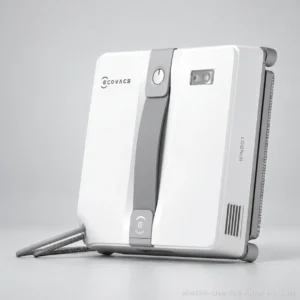
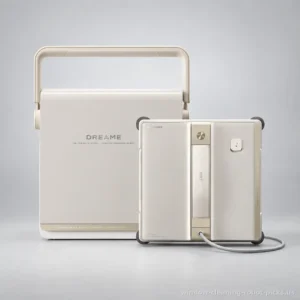
Dreame C1 Station S Kit
Top-ranked for equipment.
Read the review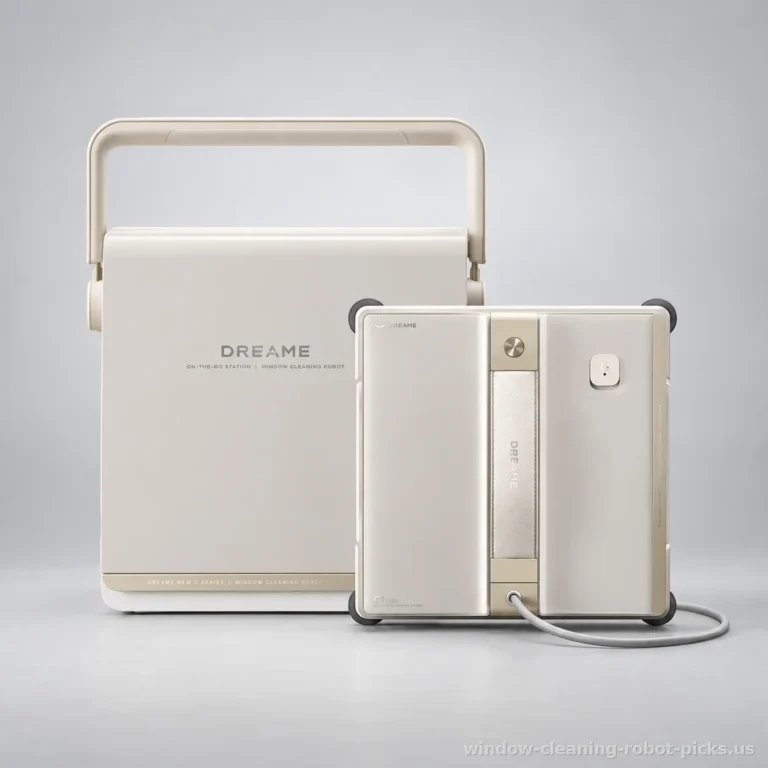 Our rankingsThe best window-cleaning robots27 window-cleaning robots
By power supply during cleaning
By manufacturer's intended use
By indoor / outdoor cleaning
By compatible surfaces
Features and options
Our guides to choosing
For regularly maintained living room windows, a window-cleaning robot with a quick cleaning mode may seem suitable. However, check that the manual confirms a short cycle, as having several programmes does not guarantee this feature.
Prices collected from retailers are for guidance only: they may have changed since, the current price is the one shown by the retailer. No price is shown for models sold only on Amazon. Amounts converted from reference prices in euros using a dated exchange rate.
Top-ranked for equipment.
Read the review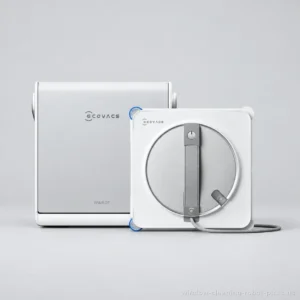
Key strength: suction pressure, rated 9.3/10.
Read the review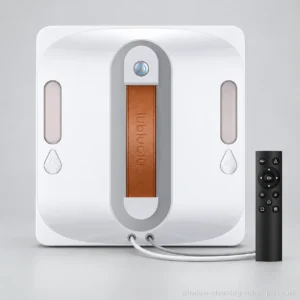
Top-ranked for water tank capacity.
Read the review| Rankings | Rating | Price | Suction pressure | Electrical power | Water tank capacity | Battery-powered cleaning runtime | Backup battery holding time | Robot height | Robot weight | Noise level | Operating radius |
|---|---|---|---|---|---|---|---|---|---|---|---|
| 1. Dreame C1 Station S Kit | 9.3/10 | $424 | 8000 Pa | n/a | 80 ml | 60 min | n/a | n/a | n/a | 63 dB | n/a |
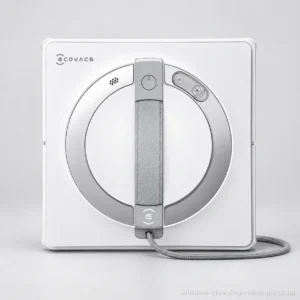
| 2. Ecovacs WINBOT W2S OMNI | 9.1/10 | $485 | 8000 Pa | n/a | 80 ml | n/a | n/a | n/a | 1.95 kg | n/a | n/a |
| 3. Lubluelu CHYW201 | 9/10 | n/a | 6500 Pa | n/a | 160 ml | n/a | 30 min | n/a | n/a | n/a | n/a |
| 4. Ecovacs WINBOT MINI | 8.7/10 | $183 | 7500 Pa | 90 W | 60 ml | n/a | 30 min | 5.5 cm | n/a | 63 dB | n/a |
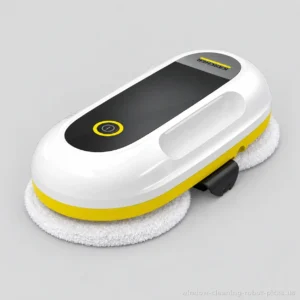
| 5. Kärcher RCW 2 | 8.3/10 | $189 | 3300 Pa | n/a | 70 ml | n/a | n/a | 7.1 cm | 1.1 kg | 62 dB | n/a |
Rankings are based on our review ratings, calculated by comparing manufacturer specifications across the full catalogue.Our methodology.
A window-cleaning robot with a quick cleaning mode can make routine cleaning of lightly soiled glass easier, provided this programme is available on the chosen model. After analysing the specifications of the 6 devices in our selection, no mode explicitly labelled as quick is documented. Multiple programmes or optimised navigation therefore do not confirm that a short cycle is available.
Such a programme would help freshen up regularly maintained windows without always running a more thorough cleaning route. This is particularly useful if you want to spread your window cleaning over several weeks. However, check the manual for the intended conditions and suitable level of dirt.
For stubborn marks or windows that have gone uncleaned for a long time, focusing solely on cleaning time may lead to disappointment. A brief programme guarantees neither the removal of all dirt nor freedom from manual touch-ups. The best choice therefore depends more on how often you clean than on a promise of speed.
To compare devices effectively, consider the total time needed for each cleaning session. The time spent moving across the glass is only part of the job. You also need to prepare the accessories, set up the robot and arrange moves between surfaces.
On a large glazed opening, the cleaning route may account for more of your time. With several separate small windows, handling may become more significant. A device suited to your window dimensions therefore remains a better choice than a model selected simply for its promise of speed.
If you are deciding between a mains-powered window-cleaning robot and an option with a mobile station, also consider how easy each is to set up in every room. This comparison helps identify the practical constraints of your home without confusing advertised runtime with cleaning time.
A domestic window-cleaning robot primarily provides cleaning assistance. It may appeal to people who want to delegate cleaning passes across the glass while still carrying out the preparation and supervision specified by the manufacturer. You must be able to position and retrieve the device safely.
Moving the device between windows remains your responsibility. Also allow for possible touch-ups on persistent marks or along some edges. Spraying systems and corner-cleaning features are worth considering, but neither alone guarantees a perfect result.
When considering your budget, think in terms of entry-level, mid-range and high-end models according to the features you actually need. A station or additional programmes do not prove that cleaning will be faster. The selection on this page helps you compare documented specifications and points to check before choosing, without making unsupported speed rankings.
To choose the best window-cleaning robot with a quick cleaning mode, first check that the manual actually describes a short cycle. None of the 6 models compared has a mode explicitly called quick in the available specifications. Multiple programmes or an optimised cleaning path are not enough to demonstrate comparable time savings.
Before buying, look in the manual for programme names, how they work and the types of dirt they are designed to tackle. If you cannot find this information, ask for confirmation for the exact model.
A short cycle may suit regular cleaning of lightly soiled windows, if the manufacturer recommends it. It does not guarantee the removal of stubborn marks. Without durations measured under comparable conditions, there is no reliable way to identify the fastest robot.
Also consider the total time needed for each cleaning session: preparing the cloths, attaching the robot, moving between windows, removing it and carrying out maintenance. A short cleaning path loses its appeal if your home requires frequent repositioning.
The comparison brings together documented features, without speed rankings or scores. An entry marked “not specified” indicates information to check before ordering.
| Model | Recorded price | Height | Length |
|---|---|---|---|
| Lubluelu CHYW201 | Check the retailer for the price | n/a | n/a |
| Ecovacs WINBOT MINI | Check the retailer for the price | 11 | 27 See more |
| Kärcher RCW 2 | Check the retailer for the price | 7.1cm | n/a |
| Ecovacs WINBOT W2 PRO | Check the retailer for the price | 7.7 | 27 See more |
| Dreame C1 Station S Kit | Check price with the retailer | n/a | n/a |
| Ecovacs WINBOT W2S OMNI | Check price with the retailer | 40.6 | 38 See more |
Measure each pane between obstructions, then identify handles, glazing bars and available clearances. A large window and several small panes present different constraints.
The Kärcher RCW 2 requires a minimum surface size of 30 × 40 cm. For the WINBOT MINI, the robot’s dimensions alone do not establish the minimum compatible pane size. Prioritise explicitly confirmed compatibility over assumptions based on a compact design.
A mains-powered window-cleaning robot requires you to check socket access and cable routing. The Kärcher RCW 2 has a 5 m cord and a built-in backup battery. This should not be confused with a power supply intended for cordless cleaning.
A window-cleaning robot connected by cable to a battery-powered station may suit a different setup. The WINBOT W2S OMNI has a mobile station with a battery; its runtime varies with the mode and how dirty the glass is.
Before choosing this solution, check the usable cable reach, station placement, safety anchor point and retrieval procedure in the event of a power failure. A backup battery and a physical safety rope are mentioned for the CHYW201.
Consider the spray system, cloth dampening instructions, cleaning paths and edge cleaning together. Pascals do not measure cleaning speed. Higher suction therefore does not help distinguish between cycles.
Dreame advertises CornerClean; the WINBOT W2S OMNI highlights TruEdge for corners and edges. These are advertised features, with no observed results available to rank them. Also check the instructions for replacing cloths during a cleaning session.
At entry level, prioritise compatibility and essential functions. In the mid-range, assess how useful the programmes and their controls are. At the premium end, a station or edge-cleaning system deserves particular attention if it addresses a real constraint.
Before choosing, check the availability of cloths, spare parts, a manual in French and after-sales support. These factors matter more than an extra feature you rarely use.
First, confirm the cycle you need in the manual, then compare devices based on your glazing, their power supply and maintenance requirements. Without documented, comparable cycle times, choose the setup that makes your cleaning session easier over a promise of speed.
Use only a cleaning solution approved in your window-cleaning robot’s manual. Compatibility depends on the device and its spray system. Before filling the tank or dampening the cloth, check the recommended liquid, whether it needs diluting and how to apply it. Automatic spraying does not mean that all detergents are suitable. Following these instructions also avoids unnecessary handling during quick cleaning.
Do not put white vinegar in your window-cleaning robot without explicit approval from the manufacturer. Using it to clean a window by hand does not guarantee compatibility with the device’s tank, seals or nozzles. Also check the instructions before applying it to the cloth. If the manual does not mention vinegar, use the recommended solution and ask customer support for confirmation.
Yes, but only if the manufacturer confirms that the model is compatible with frameless glass. A mention of edge detection or corner cleaning is not enough to establish approval. Check the manual for the exact model, the minimum supported dimensions and the securing instructions. For a window-cleaning robot for exterior windows, also check how to retrieve the device and the safety requirements.
Compatibility with sloping or horizontal surfaces must be explicitly confirmed in the manual. A device designed for windows is not automatically suitable for a glass table, a conservatory or a roof window. The Kärcher RCW 2 lists glass tables among its compatible surfaces, but this does not specify all permitted orientations. Check the permitted position and safety requirements before choosing your device.
Do not use your robot in rain or freezing weather unless its manual explicitly permits it. Stated compatibility with exterior windows does not mean approval for all weather conditions. Check the temperature limits, moisture restrictions and electrical connection instructions. With a mains-powered window-cleaning robot, also check the power supply protection requirements before setting it up outdoors.
Yes, if these surfaces are among the approved uses for the chosen model. The Kärcher RCW 2 explicitly lists mirrors and shower screens. The WINBOT W2 PRO specifications also mention mirror cleaning, but its description includes a reference to the WINBOT W2 that needs clarifying before purchase. In all cases, check the minimum dimensions, obstacles and any restrictions on surface coatings.